


Case Study: Heat Exchanger Challenges Southeast Asian Refinery
Challenges with heat exchangers at southeast Asian oil refinery caused engineers to seek Solon Manufacturing Co. for assistance.
#materials #VMAnews
Share


Field engineers at an oil refinery in Indonesia were working to resolve issues with leaking heat exchangers. The heat exchangers serve a variety of crude oils and are subject to periodic high and low temperatures.
Certain industries that utilize piping flange joint assemblies, such as petrochemical, dictate a low tolerance for leaks or fugitive emissions. Areas subject to high temperatures and thermal cycling can cause stress to flange joints, causing the bolted connections to lose tension and leak fugitive emissions.
Solon’s Solution
The team approached Solon Manufacturing Co. about live loading Solon Flange Washers, or Belleville springs with higher loads designed to be used in flange applications, onto the gasket in order to maintain sufficient bolt tension and resultant gasket stresses.
Flange washers made of H-13 tool steel are an excellent spring material option for heat exchanger applications because they withstand high temperatures and are corrosion resistant. The risk of failure fatigue is negligible due to the change in stress during temperature cycles being relatively small. The maximum heating and cooling rate are unlimited as well. Since the flange acts as a heat sink, there is no change in temperature that could damage the springs.
Results
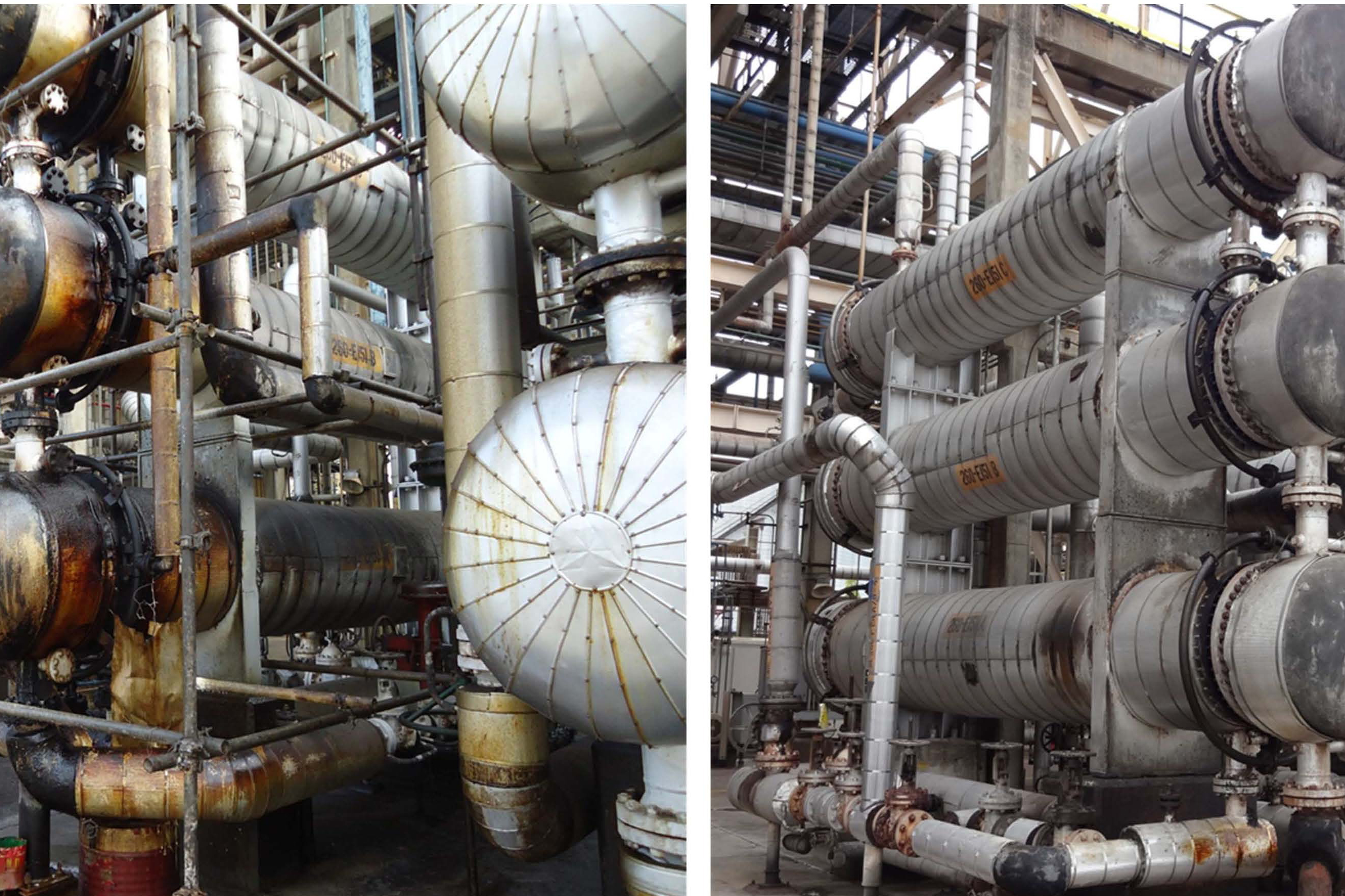
Before and after photos of heat exchangers on an Indonesian oil refinery.
Photo Credit: Solon Manufacturing Co.
The field engineers live loaded the gaskets of 17 of the leaking heat exchangers that were in service with Solon’s Flange Washers, which resolved the emissions leaks.
RELATED CONTENT
-
Control Valves for Hydrogen Applications
Proper sizing, material selection and monitoring are as important as ever.
-
Metal Additive Manufacturing: the Evolving Road to Adoption and Standardization
Greater knowledge and acceptance of metal AM valve components—especially with various standardization efforts underway—will spur the technology’s growth.
-
Dealing with Sand Erosion in Control and Choke Valves
Sand erosion in control and choke valves is a significant consideration offshore.




 Unloading large gate valve.jpg;maxWidth=214)