
Produced by


Published January 13, 2025
Emvolon, an MIT spin-off, will work with Pioneer Energy to adapt its technology at an oil and gas facility in Texas.
By Edited by Heather Gaynor
Pioneer Energy announced that it has been selected by the U.S. Department of Energy (DOE) and the U.S. Environmental Protection Agency (EPA) to adapt Emvolon’s proprietary gas-to-methanol technology to eliminate flaring and emissions in oilfields. Teh technology will be demonstrated at an oil and gas facility in Eagle Ford in Texas.
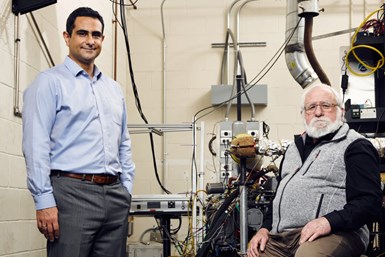
Emvolon co-founders Emmanuel Kasseris, PhD, and Leslie Bromberg, PhD.
Source: Emvolon
MIT spin-off Emvolon converts otherwise wasted methane into liquid green chemicals and fuels. Using repurposed car engines as cost-effective modular chemical plants, Emvolon converts not only the flared gas but also biogas and landfill gas into liquid green methanol. The methanol can then be trucked away to monetize what were once stranded resources at a low cost without a pipeline infrastructure while avoiding emissions.
The grant will provide funds to scale and package Emvolon’s technology, and will be demonstrated for 12 months.
“We are thrilled to receive the support of the Department of Energy to help us commercialize Emvolon’s technology, which shows tremendous promise for flaring and emissions reduction in the oilfield,” said Pioneer Energy’s CEO Eyal Aronoff. “We look forward to working closely with the DOE as well as Emvolon, as we leverage our expertise to adapt their technology for this challenging oilfield application, furthering the DOE’s goal of using new technology to improve domestic oil production and oilfield efficiency.”
“This federal grant follows on the heels of venture funding and new partnerships we announced late last year,” said Emmanuel Kasseris, CEO of Emvolon. “The capital and commitment to our technology will help us speed the roll-out and scaling of our onsite gas-to-liquid system. Working in partnership with Pioneer Energy we look forward to commercializing our technology for deployment in Texas.”